
Rooted in Oman: Salma Al Kharusi on Trust, Culture, and the Strategic Influence of Executive Assistants

Dec 19, 2025
9 min read
Behind every strong leader, there is often a presence of someone who operates with precision, discretion, and deep understanding, shaping decisions long before they reach the boardroom table. In this edition of the INSPIRE Series, we share the story of Salma Al Kharusi, Executive Assistant / Board Secretary to the Vice Chancellor at Muscat University. With a career spanning aviation, executive offices, and governance, Salma offers a compelling perspective on what it truly means to support leadership at the highest level. Rooted in the cultural and ethical foundations of Oman and the wider Arab world, her story reveals the strategic depth of the Executive Assistant role, showing how trust, thoughtful preparation, and quiet influence can shape institutional direction. More than a career reflection, this interview is also a message of encouragement, reminding us that the Executive Assistant role is not a pause, but a powerful platform for growth, leadership, and long-term impact.
🎧 Prefer listening? Enjoy this interview on Spotify.
Salma Al Kharusi | Executive Assistant / Board Secretary at Muscat University | Oman | LinkedIn
Salma Al Kharusi is an Executive Assistant to the Vice Chancellor at Muscat University, where she plays a pivotal role in governance operations and the management of the Board of Trustees and Board of Directors. With over 14 years of experience supporting senior leadership offices, following six years in customer service, she has progressed through various administrative roles, specializing in high-level meeting coordination, governance documentation, and institutional policy support. Driven by a strong interest in corporate governance and board management, Salma is advancing her professional development to strengthen her expertise in governance, compliance, and Board Secretary functions. Her aspiration is to grow into a Governance Specialist and future board leader in Oman’s higher education sector.
Elizabeth Sutkowska: Salma, your journey shows remarkable dedication, from aviation service to executive offices and now into the world of governance. When you look back, what personal qualities do you feel have carried you through the most challenging moments and shaped you into the professional you are today?
Salma Al Kharusi: When I look back on my journey, from aviation service to executive offices and now into the world of governance, I realize that what carried me through every stage were not just skills, but personal qualities that were shaped by experience, challenge, and resilience.
Working in aviation early in my career taught me the power of patience, emotional intelligence, and service excellence. In that environment, every moment mattered. You learn quickly how to stay calm under pressure, how to deal with people from all backgrounds, and how to turn stressful situations into meaningful experiences. Those years built the emotional resilience that became the foundation of my professional identity.
Transitioning into executive offices was a completely different challenge. Suddenly, I was supporting senior leaders, handling confidential matters, coordinating at a high level, and navigating responsibilities that required precision, diplomacy, and strong decision-making skills. What helped me most was my adaptability, the ability to learn fast, adjust quickly, and never hesitate to take on responsibilities that stretched me beyond my comfort zone.
One of the greatest challenges I faced was stepping into governance work without formal training at first. The world of boards, policies, compliance, and documentation can feel overwhelming, especially when you enter it from a non-academic route. But my curiosity, persistence, and commitment to learning kept me moving forward. Instead of letting uncertainty stop me, I saw it as a sign that I needed to grow. And I did, through courses, self-study, mentorship, and embracing every governance task as a chance to improve.
The qualities that shaped me the most are resilience, adaptability, and a genuine desire to serve with excellence. I learned to stand back up after setbacks, to stay grounded in difficult moments, and to always keep the bigger purpose in mind. These qualities helped me evolve from someone executing tasks into someone contributing to institutional decision-making and governance processes.
Today, as I step deeper into the world of governance and Board Secretary functions, I see how every stage of my journey prepared me not just to do the work, but to understand it, value it, and build a meaningful career through it.
Elizabeth: Your work places you right at the intersection of leadership, decision-making, and governance. If you could share one insight about the Executive Assistant role that you wish the next generation, especially in the Arab world, truly understood, what would it be?
Salma: If I could share one insight about the Executive Assistant role that I wish the next generation, especially in the Arab world, truly understood, it would be this: the Executive Assistant is not a support role; it is a strategic role.
For many years, the EA profession has been misunderstood or reduced to tasks like scheduling, organizing, and following up. But those are only the visible parts of the job. Behind the scenes, an Executive Assistant operates at the intersection of leadership, decision-making, and governance. You become the person who holds the institutional memory, protects the leader’s time and focus, and ensures that decisions are carried through with clarity and structure.
What I want young women and men entering this field to realize is that an EA is often the quiet force that keeps an organization moving. You see everything: priorities, challenges, conflicts, politics, weaknesses, and opportunities. You learn how leaders think, how strategies are formed, and how governance works in real life. If you choose to embrace the role fully, it becomes a powerful school of leadership.
But this happens only when you stop seeing yourself as “just an assistant.” You must see yourself as a partner in leadership, someone who anticipates needs, reads context quickly, manages confidentiality with absolute integrity, and communicates with clarity and emotional intelligence. Your work influences the efficiency of the institution, the credibility of the office you represent, and even the culture surrounding your leader.
The insight I wish the next generation would embrace is this: You are not in the room to take notes. You are in the room to understand. To connect. To translate strategy into action. To hold people accountable.
When the EA role is done well, it becomes one of the strongest foundations for a future in governance, operations, or leadership. I wish more young professionals knew that this job can be a pathway, not a pause, to a bigger career.
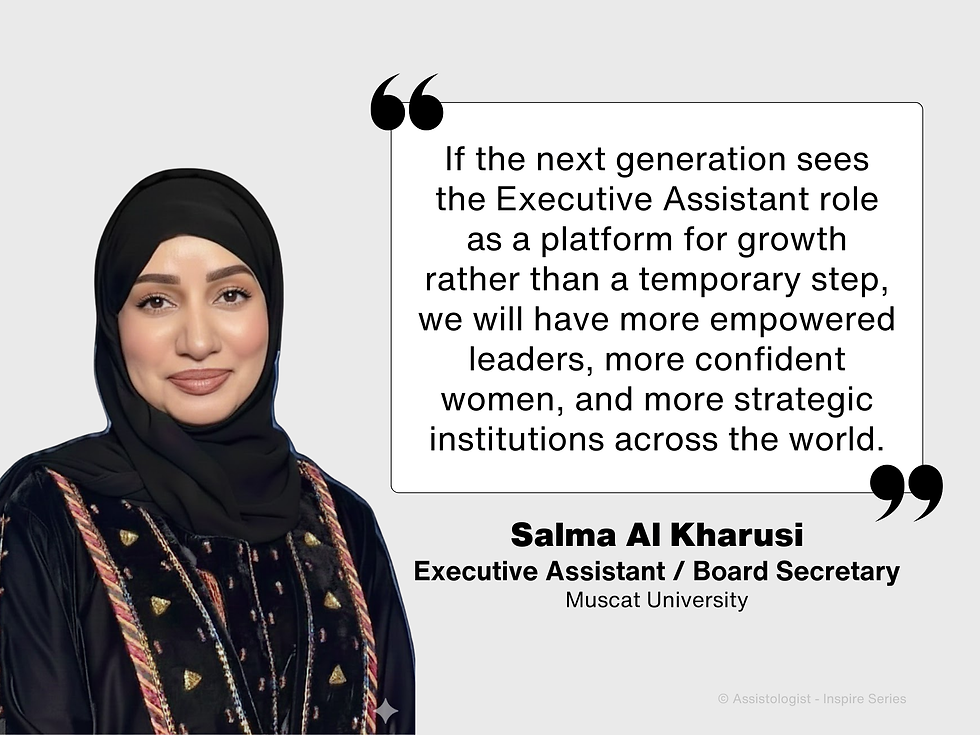
If the next generation sees the EA role as a platform for growth rather than a temporary step, we will have more empowered leaders, more confident women, and more strategic institutions across the Arab world.
Elizabeth: Having supported vice chancellors, boards, VIP visitors, and institutional partners, you’ve witnessed leadership from many angles. Was there a moment in your career when you realized: “This is more than administration, I am influencing how the organization moves forward”?
Salma: The moment I realized the full strategic weight of my role came unexpectedly. One day, the Vice Chancellor asked me to step into a Board of Directors meeting as the Acting Board Secretary, because the official secretary could not attend for personal reasons. I walked into the meeting thinking I was only covering for one session, but I walked out with a new understanding of the impact and depth of my responsibilities.
Sitting at the table, documenting discussions, ensuring clarity, and managing the flow of information made me see how central the Board Secretary function is to governance. What surprised me most was how naturally I stepped into the role. What was meant to be a one-time assignment became the beginning of a responsibility I continue to carry today.
That moment planted the seed, but the real realization came later.
During an especially demanding board preparation cycle, I found myself coordinating submissions from multiple departments, restructuring scattered information, clarifying details, and shaping documents into a coherent narrative that the Vice Chancellor and Board could rely on for decision-making. One evening, while finalizing the board pack, it struck me: I was not simply compiling information, I was shaping how leadership would understand the issues. That was the moment when my role transformed in my own eyes.
Supporting the Vice Chancellor, board members, VIP visitors, and institutional partners exposed me to leadership from different angles. I learned that governance does not happen in the boardroom alone; it begins long before, in the quality of preparation, alignment of information, and structure that supports decisions. Often, I was the person creating that structure.
Another defining moment occurred during a high-level visit, when I saw how the sequencing of information and framing of discussions directly influenced the direction of the partnership. It became clear that behind-the-scenes work quietly shapes outcomes.
From the day I stepped into that meeting “just for one session,” I stopped seeing myself only as someone supporting leadership, I became part of leadership. My influence may be quiet, but it is real, intentional, and embedded in the governance of the institution.
Elizabeth: Oman and the broader Arab region have their own unique culture of trust, discretion, and relationship-building. From your perspective, how would you describe the Executive Assistant community in Oman, and how does the local culture shape the way assistants support leaders and navigate their roles?
Salma: The Executive Assistant community in Oman and across the Arab region operates within a cultural environment where trust, discretion, and relationship-building are deeply rooted in our identity. What makes this region unique is that these values are not simply social preferences; they are drawn from the principles of Islam, which emphasize honesty, confidentiality, humility, and respect. These teachings form the foundation of how many professionals, especially Executive Assistants, approach their roles.
In Oman, I see Executive Assistants as the quiet custodians of institutional trust. Leaders depend on them not only for organizational excellence, but for integrity, sound judgment, and the ability to navigate sensitive situations with wisdom. These qualities are strongly aligned with Islamic values: الأمانة (trustworthiness), الستر (discretion), and الإحسان (excellence). An EA who embodies these principles naturally becomes an extension of the leader they serve.
Culturally, Oman places a high value on humility, harmony, and respectful communication, all reinforced by Islamic teachings. This shapes how assistants support leaders. An EA here must know when to speak and when to listen, when to mediate and when to step back, when to escalate and when to quietly resolve an issue. These are not just skills, they are reflections of cultural and religious grounding.
Relationships play a central role in the region. Trust is built slowly and protected carefully. Because of that, the EA often becomes the bridge between leadership and the wider institution, ensuring clarity, smoothing misunderstandings, and fostering alignment. In environments where hierarchy is respected, the EA’s emotional intelligence, shaped by cultural and Islamic ethics, becomes essential.
At the same time, the EA community in Oman is evolving. More assistants are stepping into governance, strategy, and board-related responsibilities. Leaders increasingly recognize that an EA who embodies integrity, discretion, and relationship-building adds strategic value to the institution.
From my perspective, the cultural landscape in Oman gives Executive Assistants a unique advantage. They work in a setting where Islamic values reinforce professional excellence. Trust becomes leadership. Discretion becomes influence. And relationships become the quiet force that keeps institutions moving forward.
Elizabeth: In Oman and across the region, so many talented women carry a quiet potential yet hesitate to step into roles that place them close to leadership, roles like executive coordination, board support, or high-level administrative partnership. Drawing from your own journey, your growth, and the confidence you’ve built over the years, what message of encouragement would you offer to women who dream of these paths but still doubt whether they’re capable or deserving of such responsibility?
Salma: When I look at Oman and the wider Arab region, I don’t see women who are “afraid to lead”. I see women who have already reached remarkable positions: ministers, ambassadors, members of the State Council and Shura Council, board members, CEOs, and senior executives. Our region is full of examples of women who carry responsibility with strength and grace.
Yet, even with these inspiring role models, many talented women still hesitate on a personal level before stepping into roles close to leadership; roles like executive coordination, board support, or high-level administrative partnership. Their hesitation is not a sign of weakness; often, it comes from humility, a deep sense of responsibility, and the fear of not being “enough”.
My message to these women is this: you are allowed to grow into the role; you don’t have to arrive fully formed.
In my own journey, I didn’t start as someone who felt completely ready. I started as someone who was willing to learn, to listen, and to say “yes” even when I wasn’t sure I was perfect for the task. Every step, from customer service to executive offices to governance and board work came with questions and doubts. But with each experience, my confidence caught up with my responsibilities.
To the woman who dreams of being close to decision-making, I would say:
You already carry the values that leadership needs: integrity, empathy, discretion, and resilience.
You don’t need a title to begin acting with a leadership mindset; start where you are.
Ask to be in the room. Volunteer to take on a project. Say yes to the opportunity that scares you a little.


Comments