top of page

Herta Wonner: From Stepping Beyond Comfort to Strategic Partnership

  • Writer: Elizabeth Sutkowska
    Elizabeth Sutkowska
  • 3 days ago
  • 5 min read

There are moments in life that require courage, the kind that asks you to step beyond what is familiar and trust that something greater awaits on the other side. For Herta Wonner, that moment meant moving from Cluj, Romania, to Riyadh, Saudi Arabia; a decision that would later become one of the most defining and transformative chapters of her life. Today, as an Executive Assistant to the Managing Director at Bosch Saudi Arabia, Herta does more than support leadership; she helps shape strategic direction, brings clarity to complexity, and contributes meaningfully to the way decisions are made. Her story is one of growth, trust, and partnership that goes far beyond the traditional perception of the Executive Assistant role.
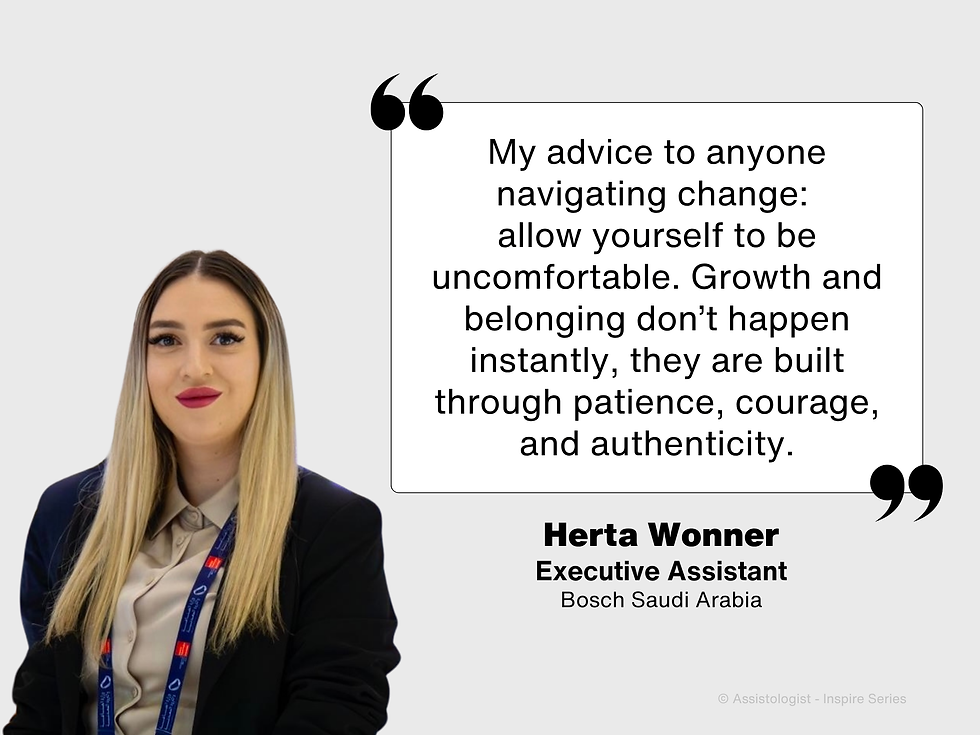

Herta Wonner - quote

Herta Wonner | Executive Assistant at Bosch | Saudi Arabia | LinkedIn

Herta Wonner is an accomplished Executive Assistant to the Managing Director at Bosch Saudi Arabia, bringing seven years of experience within Bosch and a strong foundation in operational excellence. Originally from Romania, she began her career as a working student, advancing to Specialist for Improvement Projects and later Project Manager for shopfloor activities. For the past year and a half, she has been a trusted strategic partner to senior leadership, contributing to business strategy, governance, and key transformation projects. Known for her structured mindset, resilience, and proactive leadership support, Herta embodies growth, adaptability, and continuous improvement.


Elizabeth Sutkowska: Herta, you moved from Cluj to Riyadh; what inspired your leap? You once shared that moving to Saudi Arabia turned out to be “the best thing that happened” in your life. Looking back now, what were the biggest challenges and most beautiful surprises of that transition, both professionally and personally?


Herta Wonner: Moving from Cluj to Riyadh was both a professional opportunity and a personal leap of faith. I had already grown within Bosch, and when the opportunity came and I applied to step into an international environment, I felt it was a chance to expand beyond my comfort zone.

The biggest challenge was leaving behind familiarity such as family, culture, and the certainty of what I knew. But the most beautiful surprise was discovering how much growth comes from discomfort. Professionally, I gained a broader perspective on leadership and strategy. Personally, I discovered resilience, courage, and a deeper understanding of myself. Looking back, it truly became the best decision of my life.

During my first weeks in Riyadh, I remember walking into a leadership meeting where I was the only non-Saudi and one of the youngest in the room. I felt the weight of responsibility and cultural difference at the same time. What surprised me positively was how open and respectful the environment was. Even though I was new, my perspective was genuinely considered. That moment challenged my self-doubt and showed me that competence and preparation transcend cultural boundaries.

Elizabeth: Can you please share more about that powerful moment when you realized, “I found my place.” What helped you build that sense of belonging in a new environment so different from Europe? And what advice would you give to others who are navigating big changes in their lives?


Herta: There was a moment when I realized I wasn’t just adapting, I was contributing. I felt trusted, valued, and seen not only for what I do, but for how I think. That’s when I knew I had found my place.

One situation that stayed with me was when my Managing Director asked for my opinion on structuring a strategic offsite. Instead of just organizing logistics, I was invited to shape the agenda flow, decision points, and follow-up governance. After the session, she told me the clarity of the structure helped the leadership team stay focused and outcome-oriented. That was a defining moment, and I understood that I was influencing the quality of decision-making, not just supporting it.

Belonging came from building genuine relationships, staying curious instead of judgmental, and being open to learning every day. I chose to see differences not as barriers, but as opportunities to grow.

My advice to anyone navigating change: allow yourself to be uncomfortable. Growth and belonging don’t happen instantly; they are built through patience, courage, and authenticity.

Elizabeth: You often describe your leader with warmth and admiration. How would you describe the relationship you’ve built with her, and what do you believe makes a truly successful partnership between an Executive Assistant and a leader, especially across cultures?


Herta: I deeply value the partnership I have built with my leader. It is based on trust, transparency, and mutual respect. She empowers me, challenges me, and allows me to contribute beyond traditional administrative boundaries.

One powerful example was when I was entrusted to coordinate cross-functional follow-ups on a sensitive strategic initiative. I wasn’t just sending reminders; I was aligning stakeholders, clarifying priorities, and ensuring accountability across departments. My leader empowered me to speak on her behalf in certain contexts, and that level of trust transformed my role from a support role to that of a strategic partner.

A successful Executive Assistant–leader relationship, especially across cultures, requires emotional intelligence, discretion, strategic thinking, and alignment of values. It’s not about managing a calendar; it’s about understanding priorities, anticipating needs, and protecting the leader’s energy. When trust is present, the partnership becomes a true extension of leadership.

Elizabeth: Having grown from a project management background in Romania to an Executive Assistant role in Saudi Arabia, what skills or mindsets have proven to be your “superpower” in this new chapter?


Herta: Coming from project management and improvement roles, my superpower is structured thinking combined with adaptability. I understand processes, but I also understand people.

My background allows me to see the bigger picture, not just tasks, but impact. Moving into the Executive Assistant role required shifting from operational execution to strategic partnership. The mindset that helped me most was ownership. I don’t see myself as “support.” I see myself as someone who contributes to clarity, direction, and momentum.

Recently, our calendar was overloaded with operational topics, leaving little room for strategic thinking. I analyzed recurring meetings, categorized them by value and impact, and proposed a restructured rhythm with protected strategy blocks. Within weeks, the leadership conversations became more forward-looking instead of reactive. It was a small structural change, but it created visible mental space for better decisions.

Elizabeth: You often share uplifting reflections about growth and positivity. What keeps you inspired in your day-to-day work, and how do you define success for yourself today?


Herta: I am inspired by growth, my own and the organization’s. Knowing that my work contributes to strategic direction and leadership effectiveness motivates me daily.

Success for me today is not a title. It is alignment. It’s waking up knowing I am evolving, adding value, and staying true to my values. Success means creating impact quietly but meaningfully. It means becoming stronger, wiser, and more grounded with every chapter.

A recent moment of alignment happened after a long week of high-pressure discussions. Despite the intensity, I felt calm and grounded because I knew I was operating exactly where my strengths are, bringing clarity in complexity. When your skills, values, and environment align, there is a quiet confidence. That was one of those moments.

Thank You!


Join our Inspire Series!


Every voice matters. Every story inspires.

Your story could inspire the next generations. Join the global initiative reshaping how the Executive Assistant profession is seen.


Comments


bottom of page